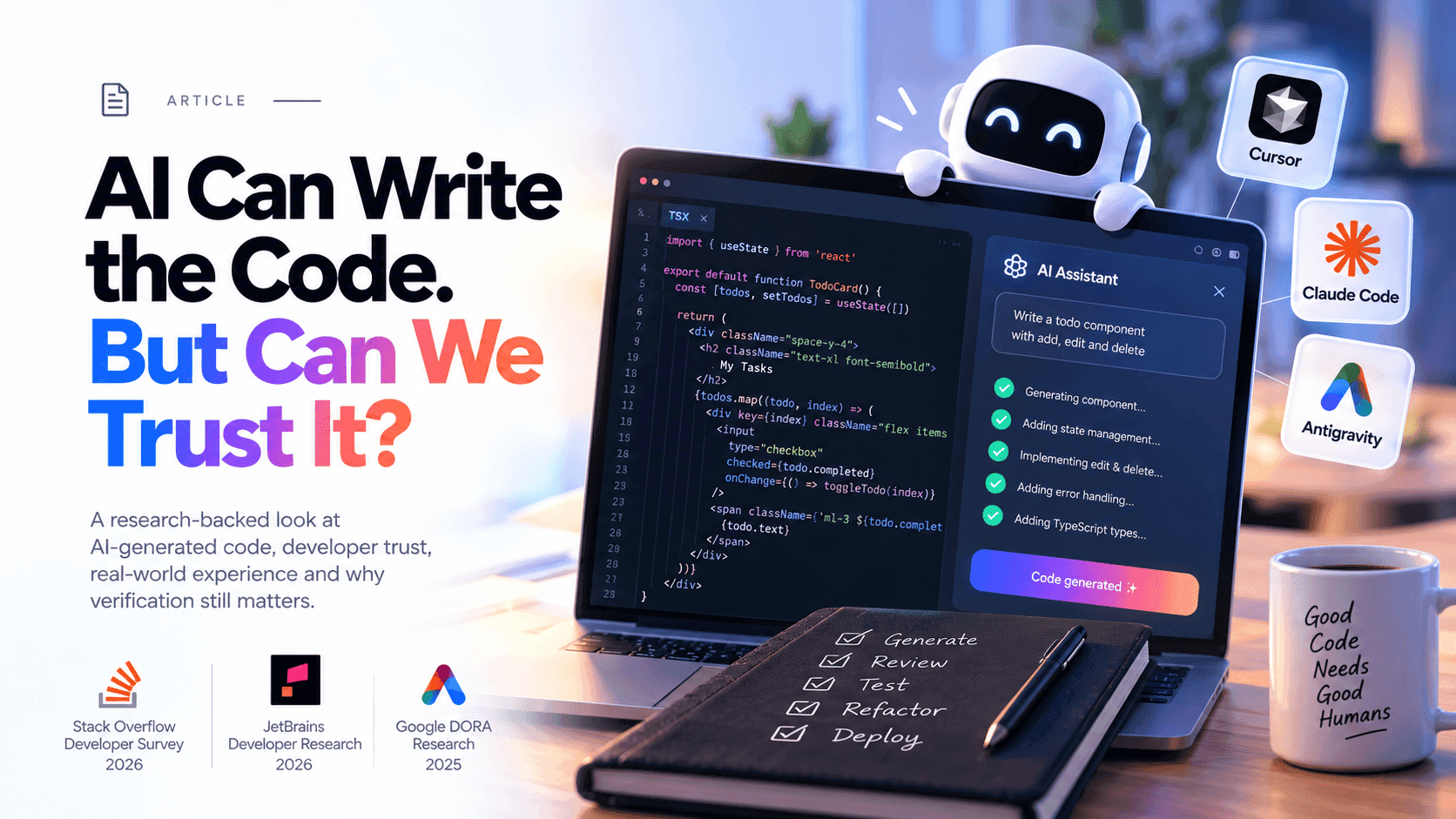
AI Can Write the Code. But Can We Trust It?
AI can generate code in seconds. Discover why verification, code quality, and engineering judgment still matter.

Rohan Yadav
Senior Frontend Developer
AI coding tools are changing how software gets built. But generating code is only one part of engineering. Understanding, verifying, and maintaining that code still matter.
A few years ago, writing code was often the most time-consuming part of building a software feature.
Today, AI can generate a React component, write an API integration, suggest a database query, or produce a first version of a test in seconds.
That changes the economics of software development.
But it also raises a question that deserves more attention:
When AI can generate code faster than we can comfortably review it, how do we know we're building something reliable?
This isn't an argument against AI coding tools. I think they can be incredibly useful. The question is whether our ability to generate code is growing faster than our ability to understand and verify it.
Recent developer research offers some interesting clues.
1. Developers Are Adopting AI Faster Than They're Learning to Trust It
According to the Stack Overflow Developer Survey 2026, 48% of respondents said they trust AI output when they can easily verify it.
Only 6.6% said they trust AI for many tasks, including important work decisions.
That distinction matters.
Developers are finding value in AI, but trust remains conditional. The ability to inspect and validate an answer is an important part of deciding whether to use it.
Think about a familiar example.
You ask an AI tool to create a React component. It generates something that looks correct, follows your instructions, and renders successfully.
But does it handle keyboard navigation? Does it account for loading and error states? Is the state management appropriate for the application? Will the implementation still make sense when the component becomes more complex?
A successful render answers only one of those questions.
The same applies beyond frontend development. Generated code can compile and still contain incorrect assumptions, missing edge cases, security weaknesses, or unnecessary complexity.
The important question isn't just whether AI can produce a working solution. It's whether we can establish that the solution is actually correct for our situation.
Source: Stack Overflow Developer Survey 2026 — AI and trust
Stack Overflow Developer Survey 2026 — AI and trust
2. AI Coding Agents Are Becoming Part of the Everyday Workflow
The adoption numbers make this shift even more interesting.
JetBrains' 2026 Developer Ecosystem research surveyed more than 15,000 professional developers worldwide.
Its findings show that 90% of surveyed professional developers used AI coding agents at work at least weekly, while 68% used them daily.
These are not simply tools that developers occasionally open to ask a question. AI coding agents are becoming part of how many developers approach their work.
And the implications go beyond autocomplete.
An agent can help explore an unfamiliar codebase, propose a refactor, generate tests, implement a feature across several files, or investigate a bug.
That can remove a lot of repetitive work.
But it can also change where the difficult work happens.
Instead of spending most of our time writing an implementation, we may spend more time defining the right task, providing the correct context, evaluating the proposed solution, and deciding whether the result belongs in the codebase.
This is especially important when working with existing products.
A greenfield demo and a production application are very different environments. A solution that looks reasonable in isolation might conflict with existing architecture, business rules, accessibility requirements, or performance constraints.
The agent may complete the task it was given while still missing the problem the team actually needed to solve.
That's why adopting AI tools and developing effective engineering practices around them should be treated as related—but separate—challenges.
JetBrains — AI Coding Agents: Adoption Trends, 2026
3. What I've Noticed While Working With AI Coding Tools
I've been exploring different approaches to AI-assisted development using tools like Google Antigravity, Cursor, and Claude Code.
One thing I've been thinking about is that choosing a coding tool is only part of the equation.
The more interesting question is how we work with the code it produces.
When an AI tool generates an implementation, getting something that looks correct is a useful first step. But I still need to understand the decisions behind it, how it fits into the existing codebase, and what needs to be tested before I can confidently rely on it.
That changes how I think about my role as a developer.
Instead of focusing only on getting an implementation working, I also need to think about how to evaluate it, where assumptions might be wrong, and whether the result is maintainable.
I'm still exploring which workflows work best for different types of tasks, but one thing is becoming increasingly clear to me: the value of an AI coding tool isn't just how much code it can generate. It's how effectively we can turn that output into reliable software.
This is also why I don't think the conversation should be limited to which tool is best.
Different tools offer different workflows, integrations, and ways of working with a codebase. But none of those differences removes the need to understand what we're building.
The tool can help with implementation. Engineering judgment helps us decide whether that implementation is worth keeping.
4. Faster Code Generation Doesn't Automatically Mean Better Software Delivery
This is where Google's DORA research becomes particularly relevant.
The 2025 State of AI-assisted Software Development report describes AI as an amplifier of an organization's existing strengths and weaknesses.
In other words, AI doesn't automatically repair the system in which software is built. It can amplify what's already there.
Consider two teams.
The first has clear requirements, reliable automated tests, thoughtful code reviews, good documentation, and a straightforward deployment process.
AI can help that team implement changes faster while its existing practices help catch problems.
The second team struggles with unclear requirements, fragile tests, inconsistent architecture, and slow feedback.
AI may help that team generate code more quickly, but the surrounding problems remain. In some cases, more generated code can mean more changes to review, more assumptions to investigate, and more potential issues to maintain.
The difference isn't necessarily which team has access to the better AI model.
It's the system around the model.
This is an important distinction because we often measure AI adoption through visible outcomes: lines of code generated, tasks completed, or features implemented.
But software delivery involves much more than implementation.
We also need to understand whether changes are correct, whether they can be deployed safely, whether they solve the intended problem, and whether the team can maintain them over time.
Making code cheaper to produce doesn't make the consequences of bad code cheaper to manage.
Source: Google DORA — State of AI-assisted Software Development 2025
Google DORA — State of AI-assisted Software Development 2025
5. What Should Developers Do Differently?
I don't think the answer is to stop using AI or manually inspect every character it generates.
That would miss the opportunity these tools offer.
Instead, I think we need to become more deliberate about where we spend our engineering attention.
Understand the problem before generating the solution
AI can work with incomplete requirements, but it cannot reliably infer every business constraint or product decision that hasn't been communicated.
Before asking it to implement something, clarify what the feature should accomplish, what constraints exist, and what success looks like.
Better context creates a better starting point.
Verify behavior, not just appearance
A page rendering correctly is useful, but it isn't sufficient evidence that the implementation is sound.
Run the code. Test important user journeys. Check edge cases. Review accessibility, performance, security, and error handling where relevant.
Use automated tests and tooling to make verification repeatable rather than relying entirely on intuition.
Review changes in the context of the codebase
An implementation can be reasonable on its own and still be a poor fit for the existing application.
Understand why a particular approach was chosen. Look for unnecessary abstractions, duplicated logic, incompatible assumptions, and changes that make future maintenance harder.
The goal isn't to reject unfamiliar code. It's to understand the trade-offs before accepting it.
Keep ownership of the final decision
AI can suggest an implementation, compare approaches, or help identify possible problems.
But someone still needs to decide whether the solution is appropriate for the product, the users, and the system.
That responsibility doesn't disappear because the code was generated rather than written manually.
6. The Valuable Skill Isn't Just Writing Code—or Prompting AI
There's a temptation to think the next generation of developers will succeed primarily by learning the best prompts or mastering the newest coding agent.
Those skills can help, but they aren't the whole picture.
A developer who understands architecture, testing, debugging, browser behavior, accessibility, and product requirements has more ways to evaluate a generated solution than someone who can only judge whether it looks right.
That doesn't mean every developer needs to become an expert in every layer of the stack.
It means we need enough understanding of the systems we work in to recognize when an answer is incomplete, when a shortcut introduces risk, and when the right solution requires a different approach.
The role is evolving from producing an implementation toward directing, evaluating, and taking responsibility for a larger part of the engineering process.
And that makes fundamentals more—not less—important.
Final Thoughts
AI coding tools are already useful, and their capabilities will continue to evolve.
I don't think the most productive response is to debate whether developers should use them. The more interesting question is how we build reliable software when a growing part of the implementation can be generated automatically.
The research points toward a consistent theme: adoption is high, trust depends on verification, and the surrounding engineering system still matters.
My own experience exploring AI coding tools has reinforced the importance of looking beyond the initial output. Generating a solution is one milestone; understanding it well enough to maintain and rely on it is another.
For me, the takeaway is simple:
The faster we can generate code, the more intentional we need to become about understanding it.
Because the goal was never just to write more code.
It was to build software that works, solves the right problems, and remains reliable after it ships.
I'd Like to Hear Your Perspective
When you're working with AI-generated code, what takes the most effort for you today?
- Understanding the generated implementation
- Debugging and fixing its mistakes
- Testing and verifying the result
- Making sure it fits the existing architecture
I'm interested in how other developers are experiencing this shift.
Research Sources
- Stack Overflow Developer Survey 2026 — AI
- JetBrains — AI Coding Agents: Adoption Trends, 2026
- Google DORA — State of AI-assisted Software Development, 2025
Stack Overflow Developer Survey 2026 — AI
JetBrains — AI Coding Agents: Adoption Trends, 2026
Google DORA — State of AI-assisted Software Development, 2025

Rohan Yadav
Senior Frontend Developer